Anker 165W Power Bank Review - Is This the Only Portable Charger You Need in 2026?
The Anker 165W Power Bank is best suited for users who rely on laptops and multiple USB-C devices while traveling or working remotely.
It is not designed for lightweight or phone-only use cases.
Its key advantage is not maximum power output, but stable multi-device charging with built-in cables that reduce the need for carrying separate accessories.
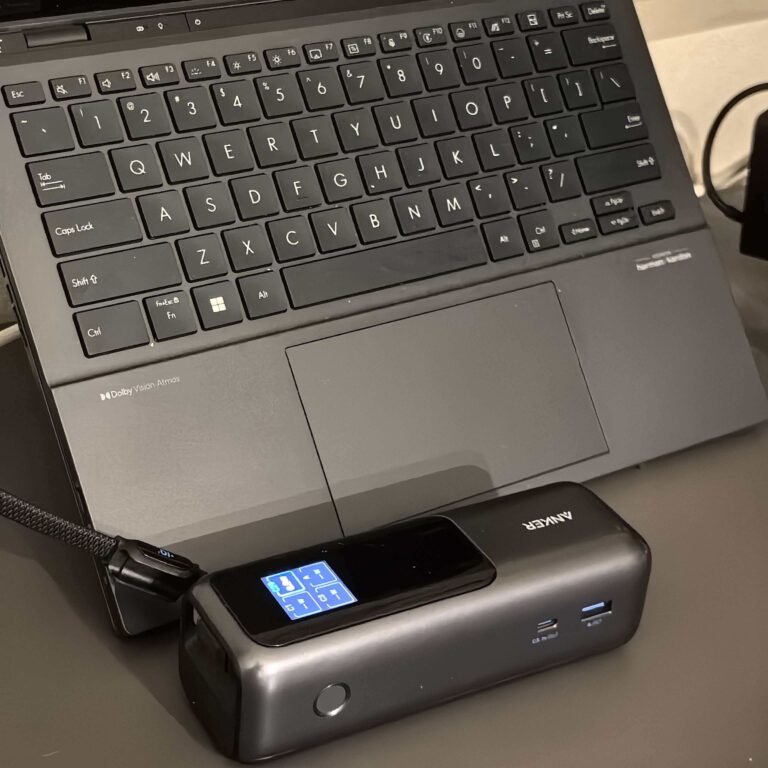
Table of Contents
Buy Recommendation
Buy if you:
- Travel frequently with a laptop
- Use multiple USB-C devices daily
- Work remotely from cafés, airports, or hotels
- Use handheld gaming devices (Steam Deck / ROG Ally / Switch)
Do not buy if you:
- Only charge a smartphone
- Prefer ultra-light travel setups
- Rarely need high-wattage charging
Specification

- A 25,000mAh battery (92.5Wh, airline compliant)
- Dual USB-C built-in cables
- One additional USB-C port
- One USB-A port
- A real-time power display
Design and Build Quality

This device is clearly designed for portability within a bag, not pocket carry.
It sits in the typical weight category of high-capacity laptop power banks.
Built-in Cable System
One of the key advantages is the integrated cable system.
It includes:
Retractable USB-C cable (~70cm)
Stored inside the device and pulled out when needed.
Secondary braided USB-C strap cable
Shorter cable that doubles as a carrying loop.
Why this matters
In real-world usage, this eliminates one of the most common friction points:
forgetting or misplacing charging cables during travel.
It simplifies mobile charging setups significantly.
Charging Performance (Real Behavior)
The device supports up to 165W total output, but power is dynamically distributed.
Typical output behavior:
- Single device: up to 100W USB-C charging
- Dual devices: power split (e.g. 100W + 65W)
- Multi-device usage: adaptive load balancing
Real-world device compatibility:
- MacBook Air: full-speed charging supported
- MacBook Pro: slower than dedicated wall charger but stable
- Smartphones: fast charging supported
- Gaming handhelds: stable sustained output
The strength is consistency, not peak performance spikes.
Real-World Use Cases
Travel
Supports laptop and phone charging simultaneously without wall power.
Reduces dependency on airport or hotel charging access.
Remote Work
Functions as a centralized charging hub for multiple devices in cafés, coworking spaces, or temporary setups.
Gaming
Maintains stable output for handheld gaming devices under sustained load.
Unlike lower-end power banks, it does not exhibit noticeable power drop during usage.
Display and Monitoring System


The LCD screen provides real-time system feedback:
- Battery percentage
- Input/output wattage per port
- Temperature status
- Charging distribution per device
This provides visibility into system behavior that most power banks do not offer.
Performance Observations
Based on real usage and USB power meter testing:
- USB-C PD output: up to ~100W per port
- Supports multiple charging standards:
- USB Power Delivery (PD 3.0)
- QC
- PPS
- AFC
- UFCS / Huawei compatibility
Power delivery is negotiated dynamically depending on device requirements.
Thermal Behavior
The device maintains stable thermal performance under load.
Typical operating temperature observed during usage remains in a safe and controlled range.
The system prioritizes stability over aggressive sustained maximum output.
Limitations
1. Weight
Not suitable for pocket carry. Designed for backpack use.
2. Cable length
Integrated cables may be limiting in some desk or hotel setups.
3. Target user
Not optimized for light smartphone-only users.
Comparison Context
Anker 165W vs Anker 737
- 737: simpler and more traditional
- 165W: better integration and cable system
Anker 165W vs Baseus 140W
- Baseus: lower cost alternative
- Anker: stronger consistency and usability
Anker 165W vs UGREEN 145W
- UGREEN: functional and cost-focused
- Anker: better ecosystem design and user experience
FAQ
Yes. It supports most laptops via USB-C at up to 100W per port.
Yes. It supports simultaneous multi-device charging with dynamic power allocation.
Yes. The 92.5Wh capacity is within TSA carry-on limits.
Yes. It supports USB-C Power Delivery up to 100W per port.
It depends on use case. It is superior in stability, integration, and convenience, but not necessary for light users.
Final Verdict
The Anker 165W Power Bank is not positioned as a simple portable battery.
It is designed to reduce charging complexity for users who rely on multiple devices during travel or remote work.
Its real value lies in consolidation, not raw specifications.
For laptop-centric users, it is one of the most practical all-in-one charging solutions currently available.
Final Rating: 9.1 / 10
Strengths:
- Stable multi-device performance
- Integrated cable system
- Strong laptop compatibility
Limitations:
- Weight
- Not suitable for minimal users
- Limited portability for pocket use