
Post: Electric Warming Tray Review
GOUKA Electric Warming Tray Review: I Tested All 4 Panels
I tested this four-panel electric warming tray at four different temperature settings to find out whether all four panels actually heat evenly—and whether the panel farthest from the power cord gets weaker.
The most interesting result came at 195°F.
After 10 minutes, I measured:
Panel 1: 193.5°F
Panel 2: 193.1°F
Panel 3: 197.6°F
Panel 4: 195.9°F
That works out to an average of almost exactly 195.0°F.
More importantly, I did not see the temperature dropping as the panels got farther away from the powered panel.
After using the controls, connecting and disconnecting the panels, cleaning them and stacking them for storage, I think that consistency—not the advertised 248°F maximum temperature—is the most interesting thing about this warming tray.
There are a few annoyances, though.
The touch controls are almost too sensitive, the temperature setting can accidentally cycle from the maximum back to the minimum, and I would prefer a longer power cord for outdoor use.
Here is everything I found.
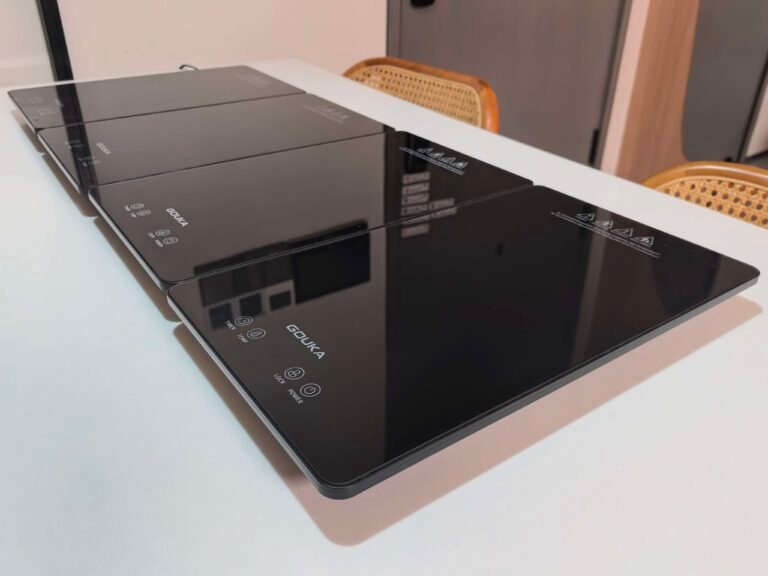
Table of Contents
We Like
One to four panels can be used depending on the meal
All four panels heated surprisingly consistently
No obvious loss of heat on Panel 4
Panels connect securely and line up neatly
Figure-8 connecting cables stay out of the way
Panels stack together for compact storage
Timer is easy to set
Child lock is genuinely useful
Seams are easy to wipe clean
We Don't Like
Power cord is not particularly long
Touch controls are easy to activate accidentally
TEMP can cycle past the maximum setting back to the lowest setting
There is no obvious MAX indicator
I sometimes forget to turn the lock on
Best for
I think this modular electric warming tray makes the most sense for:
Family dinners
Thanksgiving and Christmas meals
Potlucks
Parties
Buffet-style meals
Households serving several hot dishes at once
My Current Verdict
The modular design is not just a gimmick.
The four panels connected neatly, stored easily and—most importantly—heated much more consistently than I expected.
I still want to complete longer real-food tests before making a final judgment on how well it preserves food texture over one to two hours.
My Electric Warming Tray Test Results
I tested all four panels after approximately 10 minutes at four different temperature settings.
Each measurement was taken near the center of the warming panel.
These were manual measurements rather than laboratory tests, so small variations should be expected.
| Temperature Setting | Panel 1 | Panel 2 | Panel 3 | Panel 4 | Average |
|---|---|---|---|---|---|
| 145°F | 136.1°F | 136.4°F | 138.1°F | 145.6°F | 139.1°F |
| 165°F | 158.2°F | 158.2°F | 161.8°F | 160.8°F | 159.8°F |
| 175°F | 168.3°F | 169.5°F | 174.0°F | 171.9°F | 170.9°F |
| 195°F | 193.5°F | 193.1°F | 197.6°F | 195.9°F | 195.0°F |
There are two things I think are worth paying attention to.
First, the temperature became increasingly close to the selected temperature at the higher settings.
Second, there was no obvious pattern showing that Panel 3 or Panel 4 became weaker because they were farther from the power source.
How Accurate Is the Temperature Control?
At the lower settings, the measured surface temperature after 10 minutes was slightly below the selected temperature.
At 145°F, the four-panel average was:
139.1°F
At 165°F:
159.8°F
At 175°F:
170.9°F
At 195°F:
195.0°F
I would not interpret the lower-temperature results as evidence that the thermostat is inaccurate.
There is another possible explanation:
10 minutes may simply not be enough time for the warming surface to fully stabilize at every setting.
I plan to test this separately by recording the temperature at several time intervals after a cold start.
For now, what I can confidently say is that by the 195°F setting, the measured average was extremely close to the selected temperature.
Does the Fourth Warming Panel Get Less Hot?
This was one of the main things I wanted to test.
The first panel connects directly to power.
Panels two, three and four are connected farther down the chain.
So a reasonable question is:
Does the warming tray lose heat as you add more panels?
Based on my measurements, I did not see that happening.
Panel 4 measured:
145.6°F at the 145°F setting
160.8°F at 165°F
171.9°F at 175°F
195.9°F at 195°F
At 195°F, Panel 4 was actually slightly hotter than Panels 1 and 2.
The difference between the hottest and coolest panel at that setting was only:
4.5°F
For me, this is one of the most useful findings from the test.
If I buy a four-panel warming tray, I want all four panels to behave like warming surfaces—not one strong panel followed by three weaker ones.
So far, that appears to be the case here.
Is the Heat Even Across Each Panel?
I also checked different areas of the panels during testing.
I did not notice an obvious temperature change toward the corners.
However, I have not yet completed a formal center-versus-four-corners temperature map.
So I would describe my current finding as:
No obvious hot or cold spots were noticeable during normal testing.
I plan to quantify this more carefully later rather than claiming perfect heat uniformity based only on observation.
How the 4-Panel Modular Warming Tray Works
The box includes:
1 touch-control warming panel
3 expansion warming panels
1 power cord
Figure-8 connecting cables
User manual
The powered panel is the control center.
Plug the power cord into that panel and then connect additional warming panels using the figure-8 cables.
You can run:
1 panel
2 panels
3 panels
or
all 4 panels
Each panel is rated at approximately 115W.
All four together are rated at:
460W at 120V / 60Hz
That flexibility is the main reason this product interests me more than a conventional fixed-size warming tray.
Is the Modular Design Actually Useful?
Yes.
And I think it is more useful than the specifications make it sound.
The problem with buying one large food warming tray is that you need to store one large food warming tray.
Even if you only need that much space a few times a year.
Here, I can use one panel for a normal dinner and connect additional panels when people come over.
That means the warming area changes according to the meal.
Normal dinner
Use one panel.
Larger family meal
Use two.
Thanksgiving or party
Connect three or four.
The modular design would be less appealing if connecting everything created a mess of loose wires.
Fortunately, that was not my experience.
Are the Figure-8 Cables Annoying?
I expected the connecting cables to bother me more than they actually did.
They didn’t.
The figure-8 cables stay relatively unobtrusive once the panels are connected.
The plugs also felt secure rather than loose.
And when all four panels were connected, the panels lined up neatly.
So although a single-piece warming tray is obviously simpler, I do not think the modular connections create enough inconvenience to cancel out the flexibility they provide.
Touch Controls: Good, but Almost Too Sensitive
This is where I found my biggest usability issue.
The touch controls respond quickly.
That sounds positive.
But sometimes they respond a little too easily.
I found the TEMP control particularly easy to activate accidentally.
The warming tray starts at:
145°F
and each press increases the temperature in roughly 10°F steps until the maximum of:
248°F
The problem appears when I reach the top.
There is no obvious MAX indication.
If I continue pressing TEMP, I can go past the highest setting and end up back at the lower temperature range.
That makes it easy to overshoot the setting I actually wanted.
I would prefer one of two things:
A clear MAX indication on the display.
The control simply stopping when it reaches the maximum temperature.
Neither would fundamentally change how the product works, but both would make the interface easier to use.
The Child Lock Is More Useful Than It Sounds
Pressing LOCK activates the control lock and the screen displays:
LOC
Initially, I viewed this mostly as a child-safety feature.
After using the warming tray, I think it is also a usability feature.
Because the touch-sensitive temperature control can be activated accidentally, locking the controls once I have everything configured prevents unwanted changes.
So even without children around, I find the lock useful.
The problem is more personal:
I sometimes forget it is there.
Once I remember to turn it on, it solves one of my main complaints about the controls.
Is the Timer Easy to Use?
Yes.
While the tray is warming, pressing TIMER brings up the timer control.
The default setting is:
2 hours
A short press adds one minute.
Holding the button increases the time in 10-minute increments.
The timer can run from:
1 minute to 8 hours
When the timer reaches zero, warming shuts off.
I did not find the timer confusing or inconvenient.
For a normal family dinner, I probably would not think much about it.
For Thanksgiving, a party or a buffet where food may remain on the table for a longer period, it makes considerably more sense.
Is the Beeping Loud or Annoying?
No.
The warming tray gives audible feedback, including a beep when it is plugged in.
During my indoor testing, I did not find the sound especially noticeable.
That is actually what I prefer.
There is enough feedback to know that the control registered, without making the warmer another noisy appliance in the room.
The Power Cord Could Be Longer
For indoor use near an outlet, I think the power cord is workable.
I would not describe it as generous, though.
This becomes more relevant if you want to use the electric warming tray:
On a patio
At an outdoor party
At a barbecue
On a buffet table far from a wall outlet
In those situations, I would expect to need an appropriate extension cord.
So I would consider the cord length a minor indoor inconvenience but a more meaningful limitation for outdoor use.
Is It Easy to Clean?
So far, yes.
One concern I had with four separate panels was food getting caught in the seams.
I have not experienced that as a meaningful problem.
The gaps do not seem to create obvious dirt traps, and the flat surfaces are straightforward to wipe.
The manufacturer recommends:
Unplugging the warmer.
Letting it cool.
Wiping it with a sponge dampened with neutral detergent.
Never immersing the panels in water.
So this is a wipe-clean appliance rather than something you should wash in the sink.
The manufacturer also recommends approximately 10 cm of open space around the unit during operation.
That is worth remembering when arranging a crowded buffet table.
Storage Is One of the Best Parts of the Design
This is an area where the modular warming tray has an advantage over one oversized fixed tray.
All four panels can be stacked.
So although the warming area can become quite large when everything is connected, the product does not require that same footprint in the cabinet.
That matters because warming trays are the type of appliance many people may use heavily around Thanksgiving, Christmas and parties—and then much less frequently during the rest of the year.
A big appliance that is useful six times a year can still be annoying 365 days a year if it consumes an entire shelf.
Stacking the panels helps solve that problem.
Electric Warming Tray vs. Traditional Warming Tray
The biggest difference is flexibility.
| Feature | 4-Panel Modular Warming Tray | Traditional Warming Tray |
|---|---|---|
| Warming area | Adjustable | Fixed |
| Small meals | Use 1 panel | Full tray required |
| Large meals | Add panels | Depends on tray size |
| Storage | Panels stack | Full-size appliance |
| Setup | Requires connectors | Simpler |
| Cables | Multiple connections | Usually one |
| Best advantage | Flexibility | Simplicity |
If I always needed the same amount of warming space, the conventional design would make sense.
But if my needs change between a Tuesday dinner and Thanksgiving, I prefer the modular approach.
Electric Warming Tray vs. Chafing Dish
Both products are designed to solve the same basic problem:
Food gets cold while people are still eating.
But they solve it differently.
| Feature | Electric Warming Tray | Chafing Dish |
|---|---|---|
| Heat source | Electricity | Often fuel or electric |
| Open flame | No | Possible |
| Serving dish | Use your own cookware | Usually dedicated pans |
| Setup | Relatively simple | More components |
| Storage | Flat panels | Frames, pans and lids |
| Best for | Home meals and entertaining | Larger traditional buffets |
For home entertaining, I prefer the simplicity of putting an existing serving dish directly on a warming surface.
Traditional chafing dishes still make sense for larger buffet-style setups, especially when standardized food pans are already being used.
Is an Electric Warming Tray the Same as a Hot Plate?
No.
I would not buy this expecting it to replace a stovetop, microwave or hot plate.
The distinction matters.
A hot plate is intended to actively heat or cook food.
A warming tray is primarily intended to help maintain food that is already hot.
That is also how I would evaluate this product.
The important question is not:
Can this cook dinner?
The more relevant question is:
Can it keep dinner at a useful serving temperature while everyone finishes eating?
My current temperature testing tells me the warming surfaces can reach and maintain useful heat levels.
My next test will focus more specifically on how different foods actually hold up over time.
Best Uses for a Modular Electric Food Warming Tray
Family Dinners
Sometimes one dish is finished before another.
Sometimes one person is late.
Instead of repeatedly putting food back into the microwave, a warming tray gives you somewhere to hold already-hot dishes.
For normal dinners, I probably would not need all four panels.
That is exactly why the modular design makes sense.
Thanksgiving
This is probably the strongest use case.
The problem at Thanksgiving is often not cooking.
It is timing.
The turkey is ready.
The potatoes were ready 20 minutes ago.
Someone is still working on vegetables.
Another casserole is waiting for oven space.
By the time everything reaches the table, the dish that finished first is already cooling down.
With four warming panels, there is room to hold multiple completed dishes while the rest of the meal catches up.
Christmas and Holiday Meals
The same logic applies to Christmas dinners and other large family meals.
You do not need four panels every day.
You may absolutely appreciate four panels when six or eight dishes need to stay warm at the same time.
Parties and Buffets
Buffet food sits out much longer than food during a typical family meal.
Guests also serve themselves at different times.
That makes a larger warming area and an automatic timer particularly useful.
Potlucks
At a potluck, several dishes may arrive hot and then slowly cool while everyone waits to eat.
A modular warming system lets you add warming space depending on how many dishes actually need it.
What I Still Need to Test
There is one important area of this review that is not finished yet.
Actual food.
So far I have tested:
Four temperature settings
All four warming panels
Panel-to-panel temperature consistency
Controls
Lock function
Timer
Connections
Cleaning
Storage
General usability
I still want to run actual food tests over:
30 minutes
60 minutes
90 minutes
and
120 minutes
That matters because surface temperature only tells part of the story.
Different foods behave differently while being held warm.
For example:
Mashed potatoes can dry out.
Rice can lose moisture.
Fried foods may lose crispness.
Pizza can become softer.
Casseroles may hold up much better.
I would rather test those things directly than assume that a good surface-temperature result automatically means perfect food quality.
I will update this review once those tests are complete.
Pros and Cons
Lorem ipsum dolor sit amet, consectetur adipiscing elit. Ut elit tellus, luctus nec ullamcorper mattis, pulvinar dapibus leo.
Pros
Excellent panel-to-panel consistency
At the 195°F setting, the four panels measured from 193.1°F to 197.6°F after 10 minutes.
Panel 4 does not appear weaker
I found no obvious temperature drop toward the end of the chain.
Truly flexible modular design
One panel works for small meals; four create a much larger warming area.
Secure connections
The figure-8 cables stayed connected firmly.
Neat setup
The cables did not bother me as much as I expected.
Compact storage
All four panels stack together.
Simple timer
The timer does not require repeatedly checking the manual.
Useful control lock
Especially helpful because of the sensitive touch controls.
Easy cleaning
The seams have not caused obvious problems with trapped food.
Cons
Touch controls are too easy to trigger
The responsiveness occasionally becomes a disadvantage.
Temperature control can cycle past maximum
There is no clear MAX stop or warning before the setting returns to the lower end.
Power cord is relatively short
This could be inconvenient for outdoor entertaining.
Modular systems still require cables
A single-piece warming tray will always be simpler to set up.
Lorem ipsum dolor sit amet, consectetur adipiscing elit. Ut elit tellus, luctus nec ullamcorper mattis, pulvinar dapibus leo.
Who Should Buy This Electric Warming Tray?
I would consider it if you regularly serve different numbers of people.
The strongest buying case looks like this:
Weeknight: one panel.
Family meal: two panels.
Holiday: all four.
It is particularly well suited to someone who:
Hosts family dinners
Entertains during holidays
Serves multiple dishes at once
Uses buffet-style serving
Wants a large warming area without storing one giant appliance
Often has dishes finishing at different times
Who Should Skip It?
I would probably choose something simpler if:
You only ever need to warm one dish
You rarely entertain
You dislike visible cables
You want several completely separate warming stations
You primarily want to reheat cold food
A small single warming tray may make more sense if your warming needs never change.
Final Verdict: Is This 4-Panel Electric Warming Tray Worth It?
My favorite feature is not the touch screen.
It is not the eight-hour timer.
And it is not the advertised 248°F maximum temperature.
It is the fact that the modular concept actually seems to work.
The four panels connect neatly.
The figure-8 cables do not create much clutter.
The panels stack for storage.
And most importantly, the fourth panel did not become noticeably cooler than the first one.
At a 195°F setting, I measured:
193.5°F / 193.1°F / 197.6°F / 195.9°F
That is an average of:
195.0°F
The controls still need some refinement.
I would like a clearer maximum-temperature indicator, and I would prefer the TEMP button not to cycle straight back to the lower settings when I overshoot.
A longer power cord would also make outdoor setups easier.
But those are relatively small usability complaints.
The much bigger question was whether connecting four warming panels together would create an inconsistent, awkward system.
So far, my testing says no.
My current verdict: this modular electric warming tray makes the most sense for households whose warming needs change from a normal dinner to a large holiday meal. The four-panel temperature consistency is the strongest result from my testing so far.
I will update this review after completing longer real-food holding tests.
Frequently Asked Questions
There is no single best setting for every food.
This model starts at 145°F and can be increased in roughly 10°F steps up to 248°F.
I am still testing how different foods behave at different settings rather than recommending one universal temperature.
The maximum selectable temperature is 248°F.
In my testing, the four panels averaged approximately 195.0°F after 10 minutes at a 195°F setting.
They were quite close in my test.
At the 195°F setting, the lowest reading was 193.1°F and the highest was 197.6°F.
I did not see evidence of that.
Panel 4 measured 195.9°F during my 195°F test.
Yes.
The system can be used with one, two, three or all four panels.
I would use it primarily to maintain already-hot food rather than as a replacement for a microwave, oven or hot plate.
This is one of the situations where I think a modular warming tray makes the most sense because multiple dishes can finish cooking at different times.
Yes, particularly when food needs to remain available for an extended period.
The four-panel configuration provides more warming area, while the timer can run for up to eight hours.
Mostly.
The controls are responsive, but I found the TEMP button easy to activate accidentally.
The LOCK feature helps once the desired setting has been selected.
I would not rely on it for every outdoor setup.
Depending on the distance from the outlet, an appropriate extension cord may be necessary.
So far, yes.
The seams between the panels have not caused noticeable issues with trapped debris, and the surfaces can be wiped down once unplugged and cooled.
Yes.
The four warming panels can be stacked together instead of requiring storage space for one permanently oversized warming tray.
Not yet for a full long-duration comparison.
My current testing focuses on temperature accuracy, consistency between the four panels and usability.
I plan to add 30-, 60-, 90- and 120-minute food tests to this review.
Lorem ipsum dolor sit amet, consectetur adipiscing elit. Ut elit tellus, luctus nec ullamcorper mattis, pulvinar dapibus leo.