
SHOKZ OpenDots 2 Review: One Month Later, Here's What I Think
I’ve been using the SHOKZ OpenDots 2 for about a month, and there’s one thing I didn’t expect: I actually enjoy listening to music with them.
That might sound strange for a pair of $200 earbuds. But I’ve used clip-on earbuds before, including the Baseus MC1, and I’ve always treated them as a compromise. They’re convenient, they don’t block your ears, and they’re fine for background music. Just don’t expect too much from the sound.
The OpenDots 2 changed that a little.
Music sounds fuller than I expected. I can pick out individual instruments in busy tracks, and I don’t have to push the volume quite as hard during my subway commute.
They’re also remarkably comfortable once you figure out where to position them. I learned that part the hard way.
There are things I don’t like, though. Outdoor calls still aren’t great, and the open-ear design can’t do much about a noisy subway.
Here’s how the past month went.

Table of Contents
Specification

| Audio Technology |
Bassphere™ 2.0 + Upgraded Dolby Audio + DirectPitch™ + MirrorPitch™ |
| Microphone Type |
Triple AI Noise-Canceling Microphones (Two air-conduction mics + One bone conduction mic) |
| Sweat & Water Resistant | IP57 Sweatproof |
| Quick Charge | 5-Min = 2 Hours of Usage |
| Battery Life |
10 Hours (40 Hours with Charging Case) |
| Charge Time |
For Earbuds: 1 Hour For Charging Case: 2 Hours (Wired Charging) 4 Hours (Wireless Charging) |
| Weight |
Earbuds: 6.4g ± 0.2g Charging case: 38.8g ± 2g Total weight: 51.6g ± 2.4g |
SHOKZ OpenDots 2 Review: The Short Version
If I had to choose between the OpenDots 2 and my old Baseus MC1 today, I’d take the Shokz without much hesitation.
The sound is better, particularly when there’s background noise. The fit works well for my ears once I get the position right. And the charging case doesn’t give me the annoying Bluetooth problems I’ve had with the MC1.
But if I were buying earbuds mainly for phone calls, I wouldn’t spend $200 on these.
People on the other end of my calls have struggled to hear me outdoors. The OpenDots 2 are a little better than the MC1, but not enough to make me trust them for an important call on a noisy street.
What I like: The sound, the low-profile fit, and how little fuss there is when putting them away.
What I don’t: Outdoor microphone performance, occasional sharpness with certain vocals, and the lack of noise isolation when commuting.
There’s also one small connection issue worth mentioning. During a bike ride, the audio suddenly cut out and came back on its own. It happened once in a month, and I still don’t know what caused it.
How I Tested Them
My main phone is a Xiaomi 14. I used QQ Music for listening tests, usually at around 50–60% volume with the default sound settings.
Most of my focused listening happened at my desk. There’s a 3D printer running nearby, so my office isn’t exactly a recording studio.
I also wore the OpenDots 2 on the subway, while cycling at around 6 mph, and during normal everyday activities.
For music, I used seven tracks I know well. Each one highlights something different: bass, vocals, guitar detail, stereo imaging, or how earbuds cope when several instruments are playing at once.
I also had my previous Baseus MC1 as a reference. This wasn’t a laboratory-style, volume-matched comparison. It’s based on what I heard and experienced using both products.
I haven’t run a timed battery test or compared Dolby Audio with the feature switched on and off. I’ll keep those claims separate from what I’ve actually tested.
Sound Quality: Better Than I Expected
When I first tried the OpenDots 2, I wasn’t looking for audiophile sound. I just wanted music that didn’t feel thin or washed out.
What I got was considerably better.
The bass has some weight to it, vocals are clear, and the earbuds do a good job keeping instruments apart. Not everything is perfect, but I found myself paying more attention to the music than I usually do with open-ear earbuds.
Bass: More Bounce Than Rumble
I started with Billie Eilish’s “bad guy”, listening from 0:12 to 0:35.
The bassline has a nice bounce on the OpenDots 2. I could follow the individual beats rather than hearing everything turn into a low-frequency rumble.
More importantly, Eilish’s voice didn’t disappear behind the bass.
That’s what I care about. I don’t need bass that shakes my head. I want to hear the beat without losing everything else.
I haven’t tested the deepest sub-bass frequencies, so I can’t say how these compare with sealed earbuds at the very low end. But for the music I normally listen to, the bass was more satisfying than I’d expected from an open-ear design.
Vocals: Clear, With a Little Extra Edge Sometimes
Next was “No Time to Die”, particularly the first 45 seconds.
This is a quiet opening, and I could hear Eilish’s breathing and small details in how she delivered the words.
Those details didn’t require much effort to pick out.
Her voice sounded natural to me, and the clarity reminded me more of some of the in-ear earbuds I’ve used than of the open-ear models I was accustomed to.
I did notice something less flattering, though.
Certain “s” and “sh” sounds occasionally stood out a little too much. It wasn’t constant, and it didn’t ruin the music, but I wouldn’t call the treble perfectly smooth.
Acoustic Music and Jazz
I used the opening of Nils Lofgren’s “Keith Don’t Go” to listen for guitar detail.
The strings had a clean, distinct attack. Each pluck was easy to follow, and the guitar didn’t sound unpleasantly sharp during the section I tested.
Then I switched to “Take Five” by the Dave Brubeck Quartet.
I liked the way the saxophone sounded. The drums and cymbals also had their own texture, rather than blending into the background.
I can’t tell you whether the saxophone is reproduced with perfect tonal accuracy. I can tell you that it sounded convincing to me, and I enjoyed listening to it.
Busy Music Is Where These Surprised Me
This was my favorite part of the testing.
I played Daft Punk’s “Giorgio by Moroder” from 3:00 to 4:00, then Muse’s “Hysteria” from 0:45 to 1:15.
Both have a lot going on.
With Daft Punk, I could follow the drums, bass, and synthesizers separately. The different parts didn’t collapse into one big wall of sound.
“Hysteria” is even more demanding in a different way. Between the bass, guitars, drums, and vocals, there’s plenty of opportunity for earbuds to make everything sound crowded.
The OpenDots 2 kept up surprisingly well. I could still follow the vocals and the main instrumental parts.
That was the point where I stopped thinking of them as earbuds just for casual background music.
Stereo Imaging: Clear, but Don't Expect a Huge Soundstage
I used Yosi Horikawa’s “Bubbles” from 0:00 to 0:45.
The bouncing sounds move across the stereo field, and the OpenDots 2 made those movements easy to follow.
I could tell where the sounds were positioned from left to right.
But I wouldn’t describe the soundstage as particularly expansive. The presentation still feels mostly concentrated between the two sides rather than stretching far beyond my ears.
There’s good stereo positioning here. That doesn’t necessarily mean there’s a huge sense of space.
What About Dolby Audio?
The OpenDots 2 support Dolby Audio, but I haven’t done a proper on/off comparison yet.
I listened using the default sound settings without making custom EQ adjustments. I didn’t record the Dolby toggle’s state during those sessions.
So I’m not going to credit Dolby for a specific improvement in bass, detail, or soundstage that I haven’t isolated in testing.
What I’ve described above is what I actually heard through the earbuds.
Subway Commuting: This Is Where I Noticed the Upgrade
My Baseus MC1 had one frustrating limitation.
On the subway, I often had to turn the volume almost all the way up just to hear my music over the train noise.
With the OpenDots 2, I can usually listen at around 70–80% in similar conditions.
That’s still fairly high. I’m not suggesting it’s an ideal listening level, and percentages alone don’t tell you how much sound pressure is reaching your ears.
But from a practical standpoint, I could hear my music more easily.
This was one of the clearest improvements over the MC1 in my day-to-day use.
Of course, the OpenDots 2 don’t magically make subway noise disappear. They’re open-ear earbuds. The train is still there, and when it gets loud, that noise competes with the music.
If I wanted a quiet ride, I’d pick noise-isolating earbuds instead.
But between these two clip-on models, the Shokz worked better for me.
Cycling: Good for Music, Not So Good for Calls
I also used the OpenDots 2 while cycling at around 6 mph (10 km/h).
For music, they were noticeably better than the Baseus MC1.
At around 50% volume, I could generally follow the music outdoors. Vocals stayed clear, and pop music was enjoyable.
I did lose some of the finer details I’d heard while sitting in my office. That makes sense with the surrounding noise reaching my ears, although it means I don’t get the same listening experience everywhere.
Then there’s calling.
This is where things get less impressive.
I’ve made outdoor calls with both the OpenDots 2 and the Baseus MC1. In both cases, people on the other end had trouble understanding what I was saying.
The Shokz were somewhat better, but the difference wasn’t enough for me to feel confident using them for an important call in a noisy environment.
That’s disappointing for earbuds advertised with a three-microphone system, including a bone-conduction microphone and noise-reduction processing.
I haven’t made controlled microphone recordings under identical conditions, so I can’t quantify the difference. I’m going by what the people I called told me.
And their feedback was pretty clear: neither pair was particularly good outdoors.
I like the OpenDots 2 for listening while moving around. I just wouldn’t buy them mainly for making calls on busy streets.
As for cycling, hearing some surrounding sound doesn’t guarantee traffic awareness. I still treat road conditions, local rules, and staying attentive as more important than what earbuds I’m wearing.
Comfort: I Was Wearing Them Wrong
Here’s something I nearly missed.
The OpenDots 2 are comfortable—very comfortable, actually—but only after I figured out how to position them properly.
At one point, I wore them a little too low on my ears.
They felt okay at first. But after about half an hour, I started noticing discomfort. Nothing dramatic, but enough that I wanted to take them off or move them.
I wondered whether the clip was simply pressing too hard against my ears.
Then I adjusted the position.
Problem solved.
Once I moved the earbuds to a more suitable spot, that particular discomfort went away.
It’s a small thing, but it makes a big difference to my recommendation.
If you try the OpenDots 2 and they hurt after a while, don’t immediately assume they’re a bad fit for your ears. Try adjusting their position first.
That worked for me. It doesn’t mean it will solve every fit problem, of course, and I wouldn’t keep wearing them if they continued to hurt.
Surprisingly Comfortable When Lying on My Side
There’s another comfort detail I didn’t expect.
I can lie on my side with the OpenDots 2 on and barely notice the earbuds pressing against the pillow.
That’s not something I can say about every pair I’ve used.
I sometimes like listening to music while lying down, and bulky earbuds can make that uncomfortable.
With the Shokz, there’s very little noticeable pressure when I find the right position.
I haven’t worn them through an entire night of sleep, so I’m not recommending them as dedicated sleeping earbuds.
But for relaxing on the couch or listening to something in bed, I really like the low-profile design.
Bluetooth Connection: One Odd Interruption in a Month
Over the past month, I had one strange moment while cycling.
The audio suddenly stopped.
Before I could do anything about it, the sound came back on its own.
I didn’t have to reconnect Bluetooth, restart the music, or touch the earbuds.
I still don’t know what happened.
It could have been a temporary streaming issue, Bluetooth interference, or something else. I wasn’t able to identify the cause.
Since it happened only once, I’m not treating it as a serious connection problem.
But I don’t want to call the connection flawless either.
Apart from that interruption, I haven’t experienced a recurring audio-dropout issue.
The Charging Case Gets One Small Thing Right
This might be my favorite boring feature of the OpenDots 2.
When I put the earbuds back into the charging case, they disconnect from my phone.
Every time so far.
That sounds like the bare minimum, doesn’t it?
But my Baseus MC1 sometimes stayed connected even after I’d put the earbuds away. I’ve had other earbuds do the same thing.
It’s annoying when you put your earbuds away, play something on your phone, and then realize the sound is still being sent to the earbuds inside the case.
I haven’t had that problem with the OpenDots 2.
The magnets help the earbuds settle neatly into their charging positions. They feel easy to put away without having to fiddle around.
I can’t say whether the magnets themselves are what make the Bluetooth disconnection reliable. But the complete experience works well.
After a month, I haven’t had to open Bluetooth settings just to make sure my phone stopped talking to earbuds sitting in a case.
Small detail. Big difference to my patience.
Battery Life and Features: What I Haven’t Tested Yet
Shokz advertises up to 10 hours of playback on a single charge and up to 40 hours including the charging case.
There’s also a claimed two hours of playback from a five-minute quick charge, plus Qi wireless charging.
Other listed features include Bluetooth 6.1, IP57 dust and water resistance, multipoint pairing, automatic left/right ear detection, customizable controls, and Dolby Audio.
I’ve used the earbuds for a month, but I haven’t done a controlled test of every feature.
In particular, I haven’t timed a full battery discharge or measured how much playback a five-minute charge actually provides.
I also haven’t run a proper Dolby Audio A/B test.
Rather than repeating the marketing claims as if I’d verified them, I’m keeping those specifications separate from my hands-on observations.
SHOKZ OpenDots 2 vs. Baseus MC1
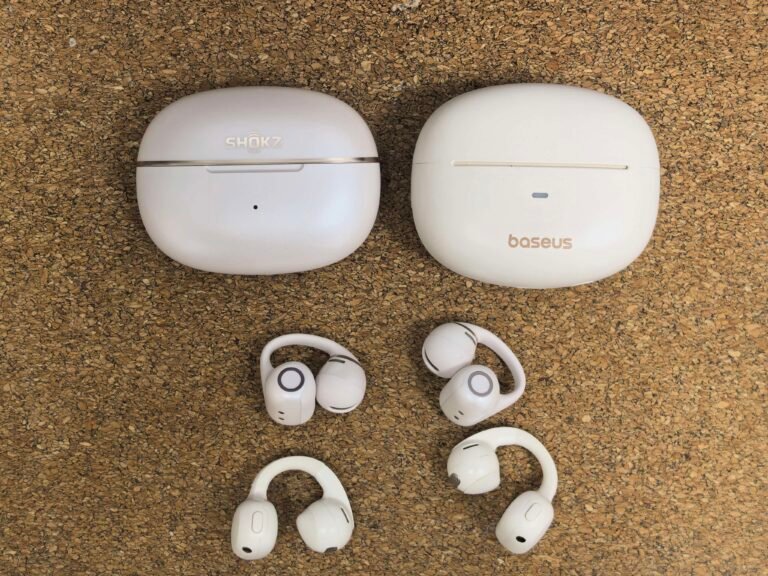
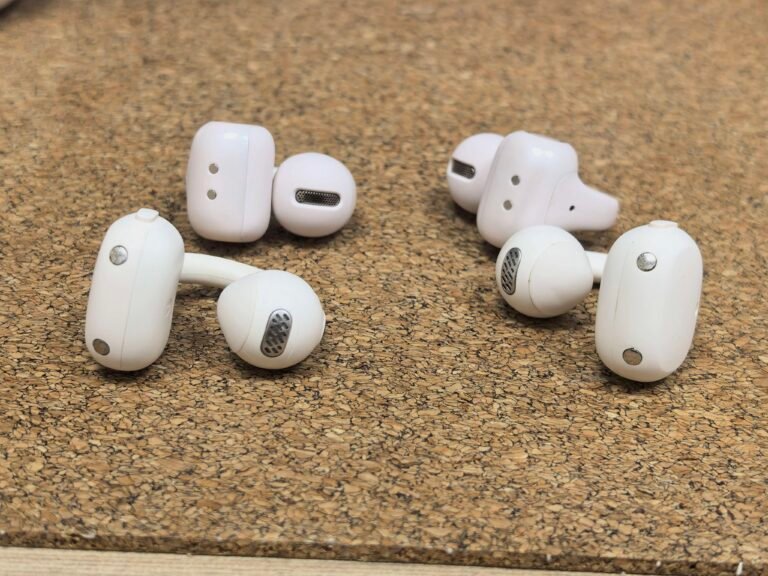
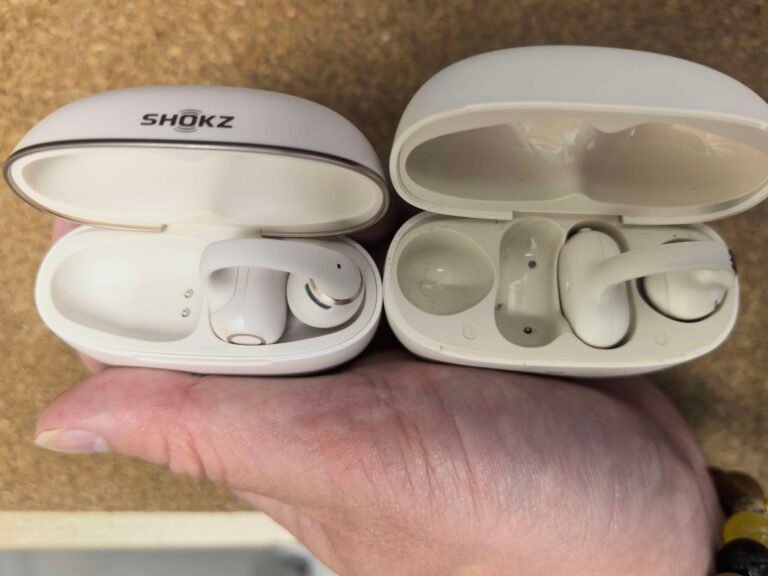
I didn’t buy the OpenDots 2 just to compare them with the Baseus MC1, but having used both made the differences easier to notice.
Here’s how they compare based on my own experience.| What I Noticed | SHOKZ OpenDots 2 | Baseus MC1 |
|---|---|---|
| Music quality | Fuller sound and clearer separation | Less satisfying in my experience |
| Subway listening | Usually around 70–80% volume | Often almost maximum volume |
| Cycling at about 6 mph | Easier to enjoy music | Noticeably less satisfying |
| Outdoor calls | Still difficult, but somewhat better | Callers also struggled to hear me |
| Returning earbuds to the case | Disconnected reliably so far | Occasionally stayed connected |
Are the SHOKZ OpenDots 2 Worth $200?
This is where I have mixed feelings.
On one hand, I really like them.
I enjoy music more than I did with my MC1. I don’t have to push the volume quite as hard on the subway. The fit is comfortable once I’ve positioned them correctly, and the charging case works without giving me little Bluetooth headaches.
Those are all real improvements.
On the other hand, $200 is a lot to spend on earbuds that still struggle with outdoor phone calls.
And if your daily commute involves a loud subway, the open-ear design might not be the best choice in the first place.
I’d be comfortable recommending the OpenDots 2 to someone who already knows they want clip-on open-ear earbuds and cares about music quality.
I’d be less enthusiastic if that person spent most of their day taking calls outdoors.
Who I'd Recommend Them To
People who want to enjoy music while keeping their ears open, don’t like the feeling of silicone tips inside their ear canals, and value comfort and everyday convenience.
I’d also recommend trying them if you’ve used cheaper open-ear earbuds and felt that the sound was lacking. That’s the situation I was in with the Baseus MC1.
Who Should Probably Look Elsewhere
People who make frequent calls in noisy places, want proper isolation for commuting, or are expecting the kind of deep bass impact they’d get from sealed earbuds.
And if the clips keep hurting your ears even after adjusting the position, don’t force the fit just because other reviewers say they’re comfortable.
Final Verdict: I'm Keeping the OpenDots 2
A month ago, I thought the SHOKZ OpenDots 2 would probably be another comfortable pair of open-ear earbuds that I’d use for background music.
They’re better than that.
I’ve enjoyed listening to Billie Eilish, Daft Punk, Muse, and jazz recordings through them. I can pick out details I didn’t expect from this type of earbud, and the sound holds together nicely even when the music gets busy.
They’re also better than my old Baseus MC1 during subway rides and outdoor music listening.
The comfort took a little experimentation. Wearing them too low caused discomfort after about 30 minutes, but adjusting the position solved it. Now I can even lie on my side without feeling much pressure from them.
And I love that I can drop them into the charging case and trust my phone to disconnect.
The microphone is the main disappointment. If someone asks me whether to buy these for outdoor business calls, my answer would be no.
But if they ask whether I’d choose them over the Baseus MC1 for music and daily use?
Absolutely.
They’re not the right earbuds for every situation. For the situations where I use them most, though, they’ve been a very good upgrade.
Frequently Asked Questions
Are the SHOKZ OpenDots 2 good for music?
Yes. I tested seven tracks covering pop, electronic music, acoustic guitar, jazz, and rock. I particularly liked the vocal clarity and instrument separation. Bass also had more punch than I expected from open-ear earbuds.
The position might be the problem. When I wore mine too low, I started feeling discomfort after about 30 minutes. I adjusted them, and the discomfort went away. If you experience pain, try repositioning the clips rather than continuing to wear them in the same spot.
I can, and they’re surprisingly comfortable against a pillow. But I haven’t tested sleeping with them through an entire night.
In my experience, they’re easier to hear than the Baseus MC1. I usually listened at around 70–80% volume on the subway, compared with almost maximum volume on the MC1. Keep in mind that open-ear earbuds don’t block train noise, and volume percentages aren’t a measure of safe listening levels.
Not particularly good in my outdoor calling experience. The person on the other end sometimes had trouble understanding me. They performed somewhat better than my Baseus MC1, but I’d hesitate to rely on them for important calls in noisy places.
Mine have done so consistently during the month I’ve used them with my Xiaomi 14. That’s been a welcome improvement over my Baseus MC1, which occasionally remained connected after being put away.
Once. The audio stopped briefly while I was cycling, then came back without me doing anything. I couldn’t determine the cause, and it hasn’t become a recurring problem.
Shokz claims up to 10 hours per charge and 40 hours including the case. I haven’t completed a timed battery test, so I can’t independently confirm those numbers.
For my needs, yes. I prefer the OpenDots 2 for music, subway commuting, and the way they behave when returned to their charging case. But both have disappointed me when making calls outdoors.
About this review: I’ve used the SHOKZ OpenDots 2 for approximately one month with my Xiaomi 14, primarily listening through QQ Music. My conclusions come from everyday use rather than laboratory testing. Where I mention manufacturer specifications, I’ve kept them separate from my firsthand observations.

