
BOYA Notra Neo Review: What I Found Testing It Against the Notra
Facebook
Twitter
LinkedIn
Reddit
I recorded the same speech with the BOYA Notra Neo and the original Notra, then compared their recordings, transcripts, and AI summaries. Both did the job, but I found a few mistakes worth knowing about before buying.
I’ve been interested in AI voice recorders for a fairly simple reason: I don’t want to spend more time organizing meeting notes than I spent in the meeting itself.
Recording a conversation is easy. Turning it into something useful afterward is where the work begins.
That’s what the BOYA Notra Neo is supposed to help with. It records conversations, transcribes them through BOYA OS, and generates summaries you can review without listening to everything again.
I also have the original BOYA Notra, which gave me a chance to compare the two.
Rather than write another review based on the specifications, I recorded the same YouTube speech with both devices and examined the results.
The Neo got plenty right. It also made some mistakes that I wouldn’t want to carry into an actual meeting record.
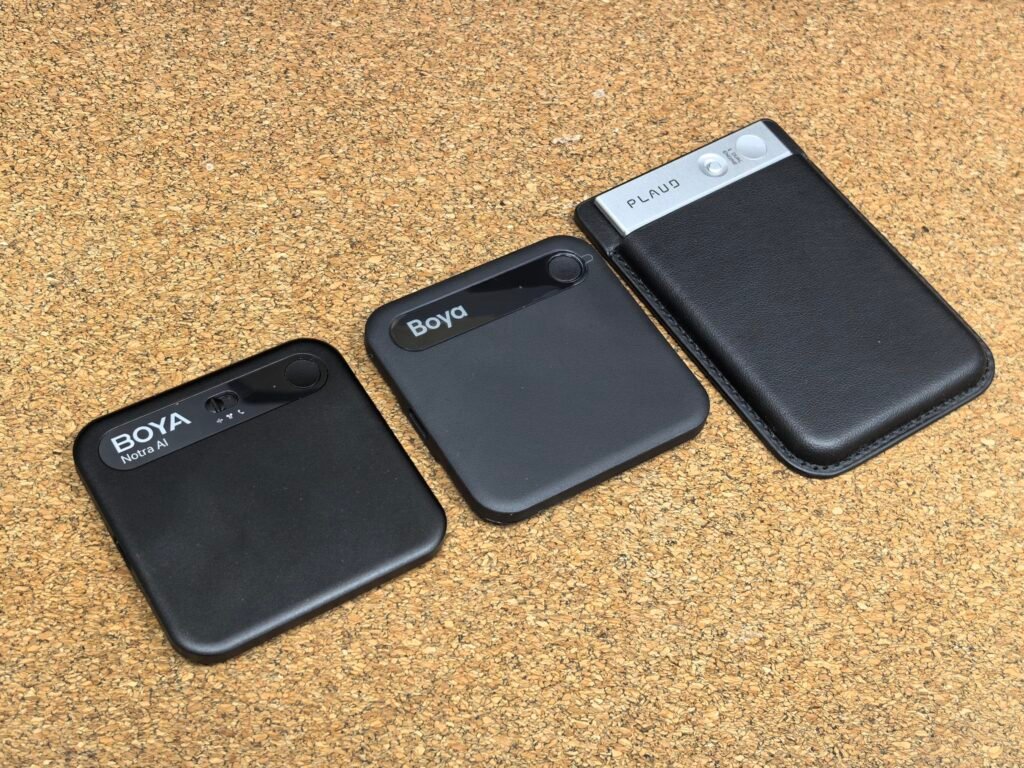
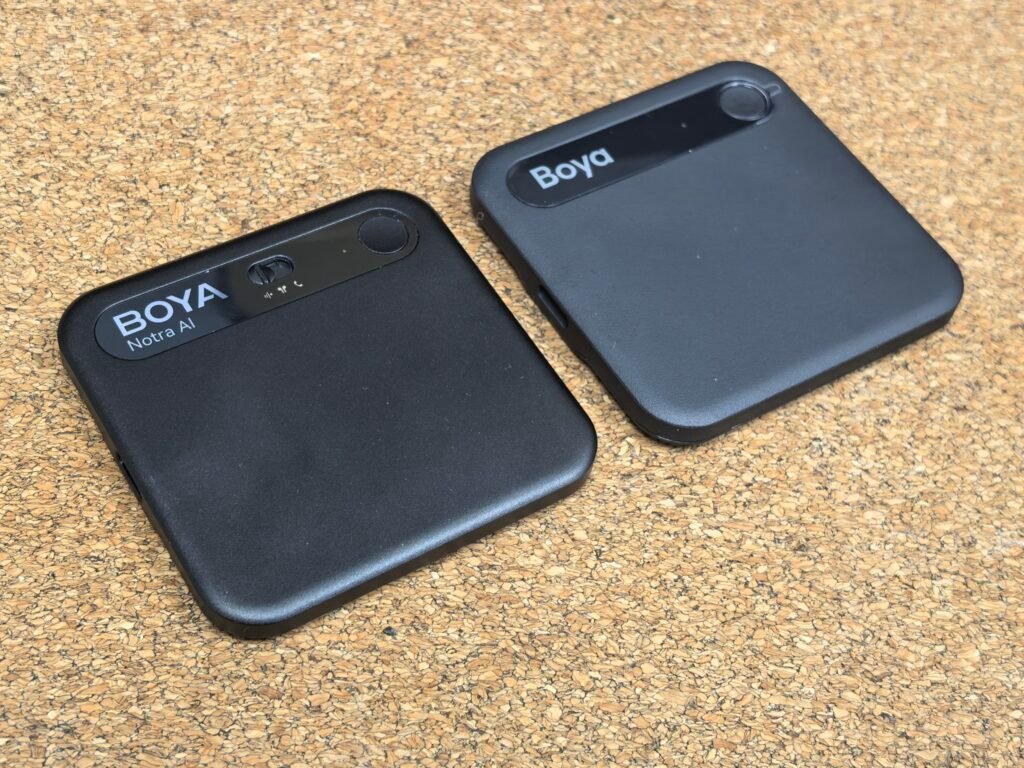
Table of Contents
My Verdict on the BOYA Notra Neo
The BOYA Notra Neo is worth considering if you want a small, dedicated AI recorder for meetings, lectures, and everyday conversations without paying extra for all the hardware features of the original Notra.
In my test, it successfully generated a recording, transcript, and structured summary. The summary was particularly useful for reviewing the main topics without reading the entire transcript.
But I wouldn’t trust its transcription blindly.
Some names were incorrectly recognized, and I found discrepancies involving important figures. The original Notra did better on several of the passages I checked, although it made mistakes of its own.
There’s another qualification: I tested both devices while they were magnetically attached to smartphones playing a YouTube speech. The original was set to Call Recording mode, while the Neo used automatic mode selection. This wasn’t a controlled microphone test.
My conclusion so far: The Neo can make recorded information easier to review, but it doesn’t eliminate the need to check important details against the audio.
Whether it’s worth buying instead of the original Notra depends largely on how much you value the extra storage, longer advertised pickup range, and manual recording controls.
BOYA Notra Neo Specs: What You Get
The Notra Neo is the more affordable model in BOYA’s AI recording lineup.
It weighs 34.5g, has 8GB of built-in storage, and supports three recording scenarios: ambient sound, phone calls, and Bluetooth headset conversations.
The main difference in daily operation is the mode selection. The original Notra has a manual switch. The Neo is designed to select the appropriate recording mode automatically.
Here are the specifications worth comparing.
| Feature | BOYA Notra Neo | BOYA Notra |
|---|---|---|
| Weight | 34.5g | 45g |
| Thickness | 8mm | 6.8mm |
| Local storage | 8GB | 64GB |
| Advertised pickup distance | Up to 5m | Up to 10m |
| Advertised continuous recording | Up to 20 hours | Up to 24 hours |
| Recording modes | 3 | 3 |
| Mode selection | Automatic | Manual |
| Charging | USB-C | USB-C |
| AI transcription | BOYA OS | BOYA OS |
| AI summaries | Yes | Yes |
These are BOYA’s advertised specifications, not results from my independent measurements.
The storage difference stands out. The original Notra has eight times the local storage.
On the other hand, the Neo is about 10g lighter. Interestingly, it’s also a little thicker than the original.
The real question is how much any of that matters once you start using it.
For someone recording a few meetings each week, 8GB may be plenty. For someone regularly recording conferences, long interviews, or full days of lectures, the original Notra’s larger storage is more attractive.
How I Tested the Notra Neo Against the Original Notra


I wanted both recorders to capture the same material so I could compare their results.
I used a YouTube video titled FULL: President Trump delivers remarks in Maryland, featuring an October 2026 speech about a shipyard project at Sparrows Point.
The speech includes company names, government officials, shipbuilding terminology, large investment figures, and some unscripted remarks.
That’s useful material for checking AI transcription. Familiar words are one thing; unusual names and numbers are another.
For the test, I attached each recorder magnetically to the back of a smartphone and played the speech through the phone.
I manually switched the original Notra into Call Recording mode. The Notra Neo was left to handle mode selection automatically.
Afterward, I compared the audio files, English transcripts, and AI-generated summaries.
The two exported recordings were not exactly the same length:
Original Notra: approximately 10 minutes, 5 seconds
Notra Neo: approximately 9 minutes, 31 seconds
I didn’t synchronize the recording start and stop points precisely, so the duration difference isn’t evidence that either recorder missed audio.
One other limitation matters here. Playing a video through a smartphone isn’t the same thing as making a real phone call. I can’t tell from the resulting files which internal recording mode the Neo selected.
This test is best understood as a comparison of the complete recording and transcription workflow, not a definitive test of microphone quality.
Transcription Accuracy: Most of the Speech Was There, but Not Every Detail
Both recorders captured the central subject of the speech.
Reading through the transcripts, I could follow the discussion about the Sparrows Point shipyard, submarine manufacturing, government funding, and projected employment.
Both transcripts also retained several specific figures, including the $3.7 billion shipyard investment, additional $2.9 billion in Navy support, and projections of 3,100 jobs in Maryland and 11,000 elsewhere.
That’s a useful starting point.
If I simply wanted to remember what a presentation was about, either transcript would have helped.
The problems became more obvious when I checked individual names and expressions.
Where the Neo struggled
One example was the name USS Billings.
The original Notra recognized it, while the Neo returned an unrelated phrase in the corresponding part of the recording.
Another issue involved a large investment figure. The two transcripts disagreed on its magnitude, which meant I couldn’t rely on the number without checking the original speech.
This is the type of mistake I worry about most with AI transcription.
Suppose you’re recording a supplier meeting. Someone mentions a product model, a purchase quantity, or a delivery deadline. If the transcript gets one of those wrong, the rest of the conversation can still look perfectly normal.
You may never notice unless you return to the audio.
The original Notra wasn’t flawless either. Its transcript used “Arsenal East” for the shipyard project, illustrating how easily a plausible-looking name can slip through.
Did the original Notra perform better?
For several of the specific passages I checked, yes.
It preserved certain names and technical references more successfully than the Neo.
But I wouldn’t turn that observation into a blanket claim that the original has better transcription accuracy.
I haven’t calculated a full word error rate using an independently verified transcript. The devices were also using different recording-mode setups.
What I can say is that both devices produced readable transcripts, but neither consistently preserved every important detail.
That distinction matters more to me than an unsupported claim of 98% or 99% accuracy.
BOYA OS AI Summaries: This Is the Feature I Found Most Useful
A transcript is useful when you need the exact wording of a conversation.
Most of the time, though, I don’t want to read ten minutes of spoken text. I want to know what happened.
Both recorders generated AI summaries through BOYA OS.
The Neo’s summary organized the speech into sections covering the shipyard project, funding, manufacturing plans, and people involved.
It also pulled out relevant figures and highlighted areas where the speech didn’t provide much detail, such as the construction timeline.
That made it easier to understand the overall discussion.
I could see myself using this kind of summary after a long presentation, particularly when I only need to revisit a couple of points.
But there was a catch.
A good-looking summary isn’t necessarily an accurate one
The Neo’s summary included recommendations about clarifying funding arrangements and publishing project milestones.
Those suggestions might be sensible. The problem is that they weren’t necessarily things the speaker asked anyone to do.
The AI had moved from summarizing what was said to suggesting what should happen next.
That’s fine if it’s clearly presented as AI advice. It’s not fine if someone mistakes it for a meeting decision.
The original Notra summary had its own problems. One section presented an inaccurate military-budget figure.
Neither result was something I would send to a client or colleague without checking.
For an ordinary lecture, that’s probably manageable. For a meeting about contracts or budgets, it matters a lot.
I’ve come away from this test with a fairly practical rule: use the AI summary to find information faster, but use the recording to confirm anything important.
The summary is a shortcut to the source, not a replacement for it.
Does the Notra Neo's Automatic Recording Mode Actually Help?
The original BOYA Notra has a physical mode switch. You select the recording scenario yourself.
The Neo is supposed to make that step unnecessary.
I like the idea. When someone starts talking about something important, I would rather press Record than spend time checking a setting.
In my test, the Neo recorded the YouTube playback and produced usable files without my manually selecting the mode.
That confirms the basic workflow worked.
What it doesn’t confirm is whether the device correctly identified what was happening.
It was attached to a phone, but the phone wasn’t in a call. It was playing a YouTube video.
I haven’t yet tested the Neo across actual cellular calls, Bluetooth headset conversations, and room recordings to see how reliably it switches between them.
So I see automatic mode selection as a potentially useful convenience, but I wouldn’t call it a proven advantage based on this test alone.
People who prefer controlling their recording setup may actually like the original Notra’s manual switch better.
BOYA Notra Neo vs. Notra: Which Would I Choose?
This is where the decision gets more interesting.
Both devices use BOYA OS for transcription and AI summaries. The biggest differences are in the recording hardware, storage, and mode selection.
If I were buying a recorder primarily for occasional meetings and personal notes, I would look seriously at the Neo.
It handles the basic recording-to-summary workflow without requiring the larger storage capacity of the original.
But if I regularly recorded long interviews or full-day events, I would be more interested in the original Notra.
The 64GB storage gives it considerably more room for files. BOYA also claims a longer pickup distance and slightly better recording endurance.
Those claims still need independent testing, but they are meaningful specification differences.
My comparison also gives the original Notra a small advantage in confidence for several difficult transcription passages. I wouldn’t put a number on that advantage yet.
The price difference matters, too. I would compare the current selling prices rather than assume the Neo is always the better deal simply because it’s the entry-level model.
I would choose the Neo for lighter recording needs and a lower upfront cost. I’d lean toward the original Notra for frequent, longer recordings where storage and hardware flexibility matter more.
Neither choice removes the need to check AI-generated notes.
The Subscription Is Part of the Buying Decision
There’s something easy to overlook when buying an AI voice recorder.
You’re not just buying a device. You’re also depending on the software that turns your audio into useful text.
BOYA OS offers a free Starter plan, with the standard advertised allowance of 320 transcription minutes per month. Paid plans offer additional transcription capacity and features.
BOYA has also advertised promotional allowances for eligible new devices, so I would check the exact entitlement shown in the account before making a decision.
For a sense of scale, 320 minutes is five hours and twenty minutes.
That could be enough if you only record a couple of short meetings each week.
It won’t go very far if you’re a student recording multiple lectures a day or someone who spends hours in meetings.
And “unlimited” plans deserve a closer look at their actual usage policies. A plan name alone doesn’t tell you everything about the service limits.
I haven’t exhausted the free allowance or tested a complete paid subscription cycle.
So I can’t tell you from personal experience exactly how every function behaves when you hit the monthly limit.
Before buying, I’d check the current BOYA OS subscription terms and decide how many hours of transcription I realistically need.
The hardware price is only part of the long-term cost.
What About Battery Life, Storage, and Recording Range?
BOYA rates the Notra Neo for up to 20 hours of continuous recording, with 8GB of local storage and a pickup distance of up to five meters.
Those are useful figures to know, but I haven’t independently verified them.
My current testing doesn’t establish how long the battery lasts in a full-day recording session, whether voices remain intelligible at five meters, or how quickly local storage fills under different recording settings.
I’m deliberately keeping those manufacturer claims separate from what I’ve measured.
If long-distance recording or all-day endurance is your main reason for buying one of these devices, I wouldn’t make the decision based solely on my transcription comparison.
Who Is the BOYA Notra Neo For?
I see the strongest case for the Neo among people who regularly need a record of conversations but don’t want to take detailed notes as they happen.
For students, the appeal is obvious: record a lecture and return to the main topics afterward. But I would still check technical terminology and important facts against the audio.
For office workers, the summary can make it quicker to revisit discussions. I would be more cautious about using AI-generated action items as an official meeting record.
For interviewers and content creators, a transcript can help locate quotations and topics. I would never publish a direct quotation without checking the recording first.
For someone recording long sessions several times a week, I’d compare the original Notra more carefully before buying the Neo.
There’s also the question of privacy and recording consent. People should know when they’re being recorded, and phone-recording consent requirements vary by location.
What I Haven't Tested Yet
This review is based on a direct comparison of one speech-recording session and the BOYA OS files produced from it.
I haven’t completed controlled pickup-distance testing, actual two-way phone-call testing, Bluetooth headset testing, or a full battery rundown.
I also haven’t verified long-term software reliability or the behavior of every subscription feature after exhausting its included transcription minutes.
Those are limitations of this review, and I don’t want to turn manufacturer specifications into claims about my own experience.
Is the BOYA Notra Neo Worth It?
After going through the recordings, transcripts, and summaries from both devices, I think the Neo makes sense for someone who wants help remembering conversations rather than someone expecting a perfectly accurate written record.
It captured the main discussion. The AI summary made that discussion easier to review. And the essential workflow worked.
But mistakes appeared in places where accuracy mattered.
The original Notra performed better on some difficult names and references in this test, although neither device produced a flawless result.
I wouldn’t buy the Neo expecting it to replace careful note-taking in high-stakes meetings. I would buy it to reduce the amount of time spent finding and organizing information after a conversation.
If your recordings are relatively short and your transcription needs fit within the available plan, the Neo is worth considering.
If you need more local storage, longer recording sessions, or additional hardware flexibility, the original Notra deserves a look.
For me, the most useful feature isn’t the recording itself. It’s being able to return to a conversation and find what matters. The Notra Neo can help with that—as long as I remember to check the details.
FAQ
In my test, it captured the main points of an English speech and several important figures, but it also made mistakes involving names and numerical details. I would verify important information against the audio rather than assume the transcript is completely accurate.
It depends on what you need. The Neo is lighter and offers automatic recording-mode selection. The original Notra has 64GB of storage compared with 8GB on the Neo, plus a longer advertised pickup range. My initial test also favored the original on several specific transcription passages, but it wasn’t a controlled hardware comparison.
BOYA advertises phone-call recording as one of its three recording scenarios. My test used a smartphone playing YouTube audio, not a real telephone call, so I haven’t independently verified two-way call performance.
BOYA OS offers a free transcription plan with a monthly allowance. A paid plan isn’t required to begin using the included free features, but additional transcription time or advanced features may require an upgrade.
Its recording, transcription, and summary features are relevant to that use case. I haven’t tested it in an actual classroom yet, so I can’t make a personal claim about lecture-hall pickup performance.
It has 8GB of built-in storage. The original BOYA Notra has 64GB.
BOYA lists Bluetooth headset recording among its supported modes. I haven’t independently tested that scenario.
Testing note: This review is based on my own comparison of the BOYA Notra Neo and original Notra using the same YouTube speech. I retained the exported recordings, transcripts, and AI summaries for analysis. Hardware specifications and subscription limits are identified separately from my test findings.
Post about Boya